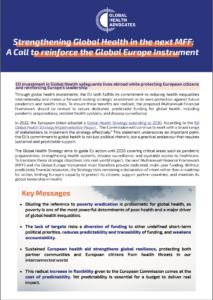
On July 16th, 2025, the European Commission presented its proposal for the EU’s next budget for the period 2028-2034, also known as the MFF (Multiannual Financial Framework) through a package of legislative proposals. The Global Europe Instrument (GEI)4 is the external facing part of the MFF package.
Our new report analyses the implications for Global Health of the GEI proposal, in an international context of dramatic shrinking of available financing and formulates recommendations to improve this crucial legislation.
Through global health investments, the EU both fulfils its commitment to reducing health inequalities internationally and makes a forward-looking strategic investment in its own protection against future pandemics and health crises. To ensure these benefits are realised, the proposed Multiannual Financial Framework should be revised to secure dedicated, predictable funding for global health, including pandemic preparedness, resilient health systems, and disease surveillance.
In her latest State of the Union address, EC President von der Leyen declared that “The second imperative is – for Europe to step up where others have stepped away. (…) And Europe must also take the lead on global health. We are on the brink – or even at the start – of another global health crisis.(…) the world is looking to Europe – and Europe is ready to lead”.
To materialise this ambition, GHA urges therefore EU lawmakers, in the Council and in the European Parliament, to improve and defend the Global Europe Instrument.
To defend the quantity of EU external budget dedicated to health, GHA recommends:
- Maintaining the overall budget of 200 bn;
- Reintroducing the binding spending target for human development, and set it at 50%
- Increasing the target of ODA spending to 93%;
- Protecting the budgets dedicated to the global pillar and to geographic envelopes earmarked for areas concentrating most health and poverty needs (including Sub-Saharan Africa) from excessive flexibility and unpredictability;
- Elevating health related specific objectives of programmes from facultative goals to legally binding obligations, by explicit mention in the articles and by limiting the capacity of the EC to unilaterally modify the annexes;
To improve the quality and effectiveness of EU ODA dedicated to health, GHA recommends:
- Explicitly reaffirming the primary objective of poverty eradication, which is also a key for solving global health challenges
- Protecting the capacity of the global pillar to contribute to effective international health cooperation, including Global Health Initiatives
- Protecting the GEI from an excessive reliance on private investment, by keeping public funding and grants central to the EU’s external action, particularly in low-income and fragile contexts and reinstate EFSD+ objectives, criteria, safeguards and principles for projects and actors eligibility. Blended finance adds complexity, reduces transparency, and can create long-term fiscal risks for partner countries, safeguards are therefore essential to ensure ODA supports equity, inclusion, and protects vulnerable populations
 ;
;