The EU is about to make one of the most consequential decisions of the next decade: shaping its 2028–2034 Multiannual Financial Framework (MFF) and the Global Europe Instrument (GEI), which will define nearly all external action financing, including humanitarian aid. In a world where development and humanitarian resources are shrinking, this is not just a budget; it is a choice about whose lives Europe will protect and what kind of global actor it wants to be.
Recent trends are alarming: for the first time in five years, official development assistance has fallen, cutting humanitarian funding by nearly 10%. In 2025 alone, at least 14 million children lost access to essential nutrition services. Needs are escalating while resources decline.
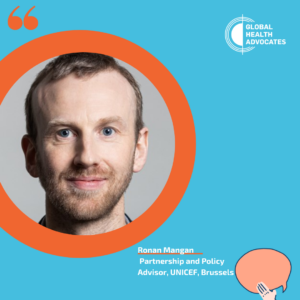
Nutrition is not optional; it is lifesaving, a human right, and a cornerstone of humanitarian response. To explore the implications of the next EU Multiannual Financial Framework (MFF) 2028–2034, including the Global Europe Instrument (GEI), we invited Ronan Mangan, Partnership and Policy Advisor at UNICEF, to share his insights.
1. Do the July 2025 MFF and Global Europe proposals adequately prioritise child survival and nutrition? Where are the gaps and opportunities?
UNICEF welcomes the proposed €200 Billion Global Europe investment, which signals the EU’s continued commitment to development and humanitarian action and demonstrates a clear recognition that sustained, strategically targeted financing remains indispensable to improving outcomes for vulnerable children. This investment not only reflects the EU’s global ambitions to remain a major international development actor, but also underlines its commitment to human rights and its credibility as a longstanding partner in advancing stability, resilience and opportunity for children worldwide. The proposal also reaffirms the EU’s dedication to effective multilateralism, a principle fundamental for achieving the SDGs and responding to cross-border crises. Ensuring that this commitment translates into measurable results will be key to maximising the EU’s return on investment for children.
Despite this, the July 2025 proposals for the MFF and Global Europe Instrument fall short of fully prioritising child survival and nutrition. Crucial features of the current NDICI, most notably the 20% human development spending target, have been removed. This is a missed opportunity to ensure greater effectiveness in EU global action given the strong evidence base: child immunisation yields a 54:1 return, early childhood development generates 6–17 times the original investment, and child nutrition delivers a 23:1 return. These are among the most effective investments in any development portfolio. The proposal’s elimination of the 10% spending target on forced displacement and migration is a source of concern, as displaced children face the highest risks of malnutrition, preventable disease and early mortality. We know that global needs are continuing to rise: only 17% of SDG targets are currently on track, progress has stalled or regressed on more than one-third, and by 2030, fragile contexts will be home to 86% of people in extreme poverty. The removal of a dedicated human development programme risks fragmenting EU action at a moment when coherence, predictability and long-term system strengthening are urgently required – and needs are at their highest in generations.
Still, the proposals contain important opportunities. The alignment with SDG 2 (Zero Hunger) creates space to strengthen EU investments in climate resilient agriculture, food systems, and local nutritious food production, measures essential to reversing global stunting trends. The explicit recognition of fragility and resilience also allows the EU to scale anticipatory action, which the UNICEF, in our MFF (2028-34) position paper, notes is both lifesaving and cost-efficient, particularly in agriculture dependent settings. Additionally, the emphasis on women, children and youth in the new subregional envelopes offers potential to integrate nutrition more systematically into public health, education and social protection reforms. These building blocks provide viable avenues to elevate nutrition and child survival, provided they are matched with clear prioritisation and safeguards.
Global Gateway also provides a practical avenue for scaling nutrition relevant investments by enabling blended finance solutions that support climate resilient agriculture, cold chain logistics, food processing, and local production of fortified foods, all critical to preventing child malnutrition in increasingly volatile environments. In addition, measures aiming at strengthening the public systems that deliver essential nutrition services by investing in digital health, primary care infrastructure and social protection platforms that detect and respond to undernutrition earlier and more efficiently are crucial and conditions for the Global Gateway to have the optimal impact.
2. Why must nutrition be explicitly prioritised in the next MFF and GEI, and what are the main political, financial or structural challenges?
Nutrition must be explicitly prioritised because it is one of the most transformative and cost-effective investments the EU can make. Again, as highlighted in our MFF position, child nutrition programmes deliver an estimated 23:1 return on investment, making them foundational for human capital, cognitive development, school readiness and long-term economic growth. Nutrition is also central to achieving SDG 2, which remains severely off track. The global financing gap for the SDGs now stands at $4 trillion annually, and over 60% of low-income countries are in debt distress, drastically limiting their ability to invest in primary health care, child nutrition and social protection systems. Without explicit prioritisation, children risk being left behind as global hunger, climate shocks and food insecurity intensify.
In fragile and crisis affected settings, where the EU seeks to deepen engagement, malnutrition remains a leading cause of child mortality. By 2030, fragile contexts are projected to host more than a quarter of the global population and the overwhelming majority of those experiencing extreme poverty. Malnutrition is further exacerbated by climate related shocks, conflict, and displacement, all of which disproportionately impact children. Nutrition interventions are therefore not only lifesaving but stabilising, reducing downstream humanitarian needs and contributing directly to the EU’s geopolitical objectives.
However, several challenges threaten the integration of nutrition into the new MFF and GEI. Politically, escalating security concerns and competing priorities risk reducing space for human development. Financially, the merging of grants, guarantees and loans could weaken grant based cooperation, which is essential for nonrevenue generating social sectors such as nutrition, health systems and education. Structurally, the removal of thematic spending targets, in the GEI proposal, diminishes safeguards that previously helped secure minimum allocations to human development. in this context adequate and predictable multiyear funding is indispensable for building national health and nutrition systems, yet predictability may be harder to ensure under the revised structure.
It is in this context that the EU’s commitment to multilateralism, must be operationalised more effectively. UNICEF and sister UN agencies hold unique comparative advantages, through their country presence, and particularly in fragile contexts where national systems are weakest and the risk of child malnutrition highest. Strategic partnerships with the UN in EU external action is not only normatively important but also operationally necessary to deliver the scale, equity and return on investment that nutrition interventions require. Ensuring that EU financing mechanisms are open, competitive and inclusive of UN actors, but also civil society organisations, will be essential to achieving the EU’s ambitions for global development and child wellbeing.
3. What risks does UNICEF identify for children if donor solidarity declines, and how important is the EU’s role, especially in fragile and crisis settings?
A continued decline in international solidarity would have severe and far-reaching consequences for children. With global crises compounding and resources becoming increasingly constrained, reductions in ODA expose children to heightened risks of hunger, disease, interrupted education, violence and displacement. Currently, only 17% of SDG targets remain on track, and progress is regressing in areas closely tied to children’s wellbeing. Meanwhile, 86% of individuals in extreme poverty are projected to live in fragile contexts by 2030, where climate shocks, conflict, and market disruptions most severely affect children. As national budgets tighten, particularly in countries suffering debt distress, critical services such as primary health care, nutrition support and education become harder to sustain. Without sustained donor engagement, UNICEF anticipates dramatic rises in acute malnutrition, preventable child deaths, school dropout, child labour and early marriage. Hard-won development gains risk unravelling rapidly.
In this deteriorating context, the EU’s role is pivotal and irreplaceable. The EU remains one of the world’s largest champions of children’s rights, human development and multilateral governance, and its investments generate strong returns in both development and stability. The €200 million Global Europe allocation and the proposal to dedicate €25 billion to humanitarian aid demonstrate the EU’s commitment to addressing children’s needs where they are most acute. Furthermore, ODA generates significant value: every euro invested in children produces substantial social and economic returns, with child focused interventions ranking among the most effective levers of long-term stability. Crucially, predictable, multiyear EU support prevents the shift to short-term, reactive programming that is more costly and less effective.
As donor solidarity declines and fragility deepens, Global Gateway can play a decisive role in mitigating risks for children by directing investment toward human-centred and resilience building infrastructure. By prioritisingprojects that strengthen food systems, enhance access to essential health and education services, and build climate resilient communities, Global Gateway can help shield children from the cascading effects of conflict, hunger and instability. Integrating anticipatory action and risk informed planning into Global Gateway programming would further ensure that crises are addressed before they escalate, an approach which is both lifesaving and cost-efficient. In this way, Global Gateway becomes not only an instrument of connectivity but also a strategic pillar in preventing humanitarian deterioration, protecting children’s futures and reducing the long-term costs of crisis response.
To end, the EU’s cooperation with multilateral partners, including the UN, supports principled, neutral and needs based delivery, particularly in fragile and hard to reach settings and remains an important factor in ensuring that EU investments achieve scale and reach the most vulnerable children. Ultimately, reduced EU investment would not save resources; it would export instability and suffering back to the EU’s borders. Sustained, child centred EU leadership is therefore not only a moral imperative, but also a matter of strategic self-interest.
Ronan Mangan is a Partnership and Policy Advisor with UNICEF’s Public Partnership Division, based in Brussels, where he leads engagement with the EU Institutions. He advances UNICEF’s policy and partnership priorities across EU external action, ensuring children’s rights are central to EU budgetary, development and humanitarian policies. His work focuses on strategic EU engagement and evidence‑based dialogue to strengthen results for children worldwide.

 ;
;