As the world continues to face multiple, protracted crises, the European Union continues to position itself as a key actor in global health. Building on its previous commitments to health in its external action such as its 2022 Global Health Strategy, it recently adopted a Global Health Resilience Initiative (2026), seeking to improve prevention, preparedness and response to future health threats.
Yet, just a few years after the COVID-19 pandemic underscored the importance of global solidarity and prompted a significant increase in health Official Development Assistance (ODA), multicrises have led to global health being deprioritised. Instead of sustained health investments, EU health ODA decreased in 2023 and stagnated in 2024. Recent withdrawal from historical donors has also significantly threatened progress towards achieving health equity, human development and the Sustainable Development Goals (SDGs). Members of the European Parliament have warned that an additional USD $4 trillion is needed to fill the SDG investment gaps before the 2030 deadline, and called for an increased budget for external action in the next multiannual budget (MFF) for 2028-2034. Member States, on the other hand, are proposing cuts to the next budget, disproportionately reducing external action, as seen in the Cypriot MFF negotiating box. Despite strong political signals from the Council itself stating that ‘financing international partnerships remains a cornerstone of the EU’s global agenda and foreign policy objectives’, and that the EU should ‘sustain measures to deliver health equity for the furthest behind’. As the latest OECD projections point to a sharp decline in health financing, bilateral health aid from major donors is at risk of falling by up to 46% from major donors between 2024 and 2026.
If the EU is serious about becoming a reliable global health partner, it must stop treating global health as an optional budget line that can be sacrificed in times of fiscal pressure. This challenge appears particularly urgent as the world continues to face the threat of high-consequence infectious diseases, from Mpox to Ebola. Investing in preparedness and addressing structural vulnerabilities to build strong, more resilient health systems can no longer be put aside as a matter of global solidarity. These investments need to be embedded in the next MFF and Global Europe Instrument. Now more than ever, it is a fundamental investment in collective security.
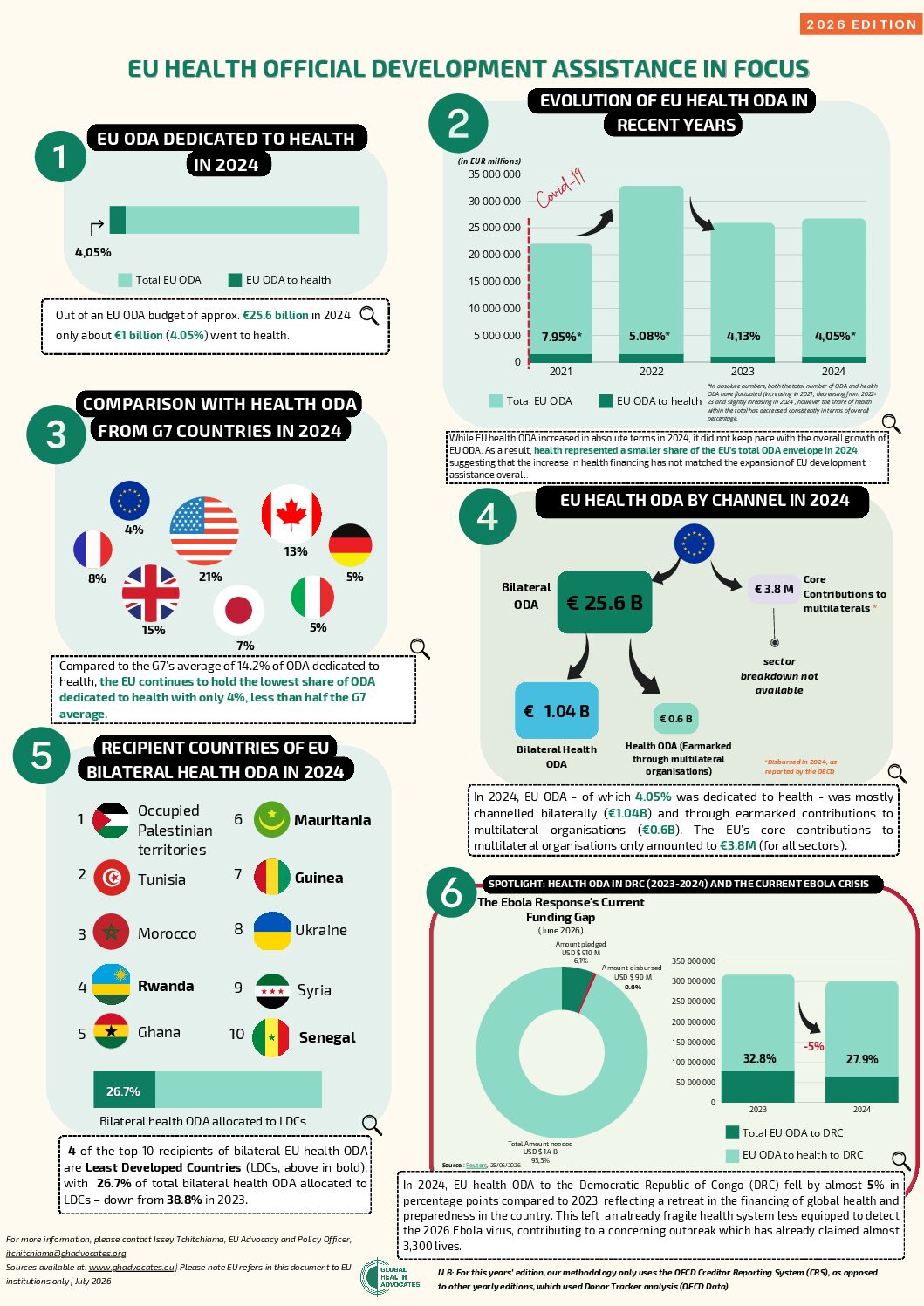
Global Health Advocates is proud to publish an updated analysis of key figures in the EU’s Official Development Assistance (ODA) dedicated to health in 2024, highlighting the most recent trends in EU health ODA contributions. These analyses seek to inform discussions on whether current EU Financing trajectories align with their stated global health ambitions.
Please note that the term “EU” refers in this document to the EU institutions only.
Sources and Methodology
- For this edition, Global Health Advocates’ calculations for the figures listed beneath are solely based on the OECD’s latest official development assistance figures from its Creditor Reporting System, as opposed to other yearly editions of our fact sheet, which used Donor Tracker analysis. GHA also uses yearly OECD exchange rates.
- EU ODA Dedicated to Health in 2024 (Figure 1);
- Evolution of EU Health ODA in recent years (Figure 2);
- Comparison with Health ODA from G7 countries in 2024 (Figure 3);
- Health ODA by channel (Figure 4);
- Recipient countries of EU bilateral health ODA (Figure 5);
- Spotlight: Health ODA in DRC (2022-2024) and the current Ebola Crisis (Figure 6).
- For Figure 4 (Health ODA by Channel in 2024), GHA’s calculations are based on an analysis from the OECD CRS. Please note the ‘bilateral figures’ are bilateral disbursements from EU institutions to the health sector in constant EUR million. In this total, earmarked funding channeled through multilateral institutions is considered as bilateral ODA, as it is not attributed to multilateral ODA in their terminology.
- To be precise, the OECD refers to multilateral ODA as core contributions to multilateral organisations’ budgets, unmarked by sector or recipient, and does not include the breakdown by sector in its data. As such, the multilateral disbursements from EU institutions to the health sector as multilateral funding (disbursements) by sector (in this case, for health) is not available.
- For core (contributions) multilateral ODA for health, the data is therefore not available either. Using the providers’ total use of the multilateral system would also technically be incorrect, as it indicates the core contributions to multilateral organisations whose reported activities fall under Health ODA, and not the amount of core funding disbursed directly to health.
- Finally, the memo item of ‘imputed multilateral by sector’, is an OECD estimate of multilateral ODA contributions to a given sector, based on the sectoral distribution of the commitments made by multilateral organisations, and applied to the core contributions that each donor made to the corresponding organisation, but is not available for health in 2024, nor regarding donors’ disbursements (only commitments). However, as EU Institutions only made about USD 3.5 million in total core multilateral disbursements in 2024, we can assume the share for the health sector is not significant.
- For Figure 5 (Recipient Countries of EU Bilateral Health ODA in 2024), Global Health Advocates’ calculations are based on the latest official development assistance figures shared by EU Institutions and OECD DAC members in the EU Aid Explorer.
- For Figure 6 (Spotlight: Health in DRC 2022-2024 and the current Ebola crisis), Global Health Advocates’ calculations are based on the EU Aid Explorer.
The data used for this edition was last updated on 10/07/2026.
For more information, please contact:
Issey Tchitchiama
EU Advocacy and Policy Officer
 ;
;